A vision rooted in amanah
Amanah — trust, responsibility, integrity — is not just the name of this platform. It is the principle that should govern every masjid in the country. Our vision is to make that possible.
Officers of the Charity. Officers of the Masjid.
Two distinct roles. Two distinct arenas. One community served well.
The Masjid Amanah governance model is built on a single, clear distinction that Islamic tradition has always understood: those who govern the institution and those who lead the community are different people, with different roles, different accountabilities, and different arenas.
When those roles are separated — clearly, constitutionally, and enforced by the platform — masajid function at their best. The Officers of the Charity govern quietly in the background. The Officers of the Masjid lead visibly at the front. Neither above the other. Neither is the other.
This is not a complicated model. It is the right model — and for the first time, there is a platform built to make it simple.
Accountable to the law
The Chairman, Treasurer and Secretary are the backbone of the charity — not the face of the community. Their arena is the boardroom, the accounts, and the governance record. They are largely invisible to the average musallee. That is by design.
Their role is not to lead. It is to protect. They ensure the constitution is followed, charity law is met, and the Charity Commission's expectations are satisfied. They govern — they do not manage. They do not control communications. They do not determine what the community hears and when.
The platform carries the constitutional knowledge. Trustees follow the workflow. Blind voting ensures no single trustee can determine outcomes alone. Minutes are auto-drafted. The quarterly report is auto-generated. Governance becomes light touch — but legally watertight.
Every quarter, the trustees stand before the musallees — not to report on themselves, but to report on the Amir and the Service Councils. The recognition flows to the people doing the visible work.
Light touch governance. The app does the work. The trustees follow the process. The community is protected.
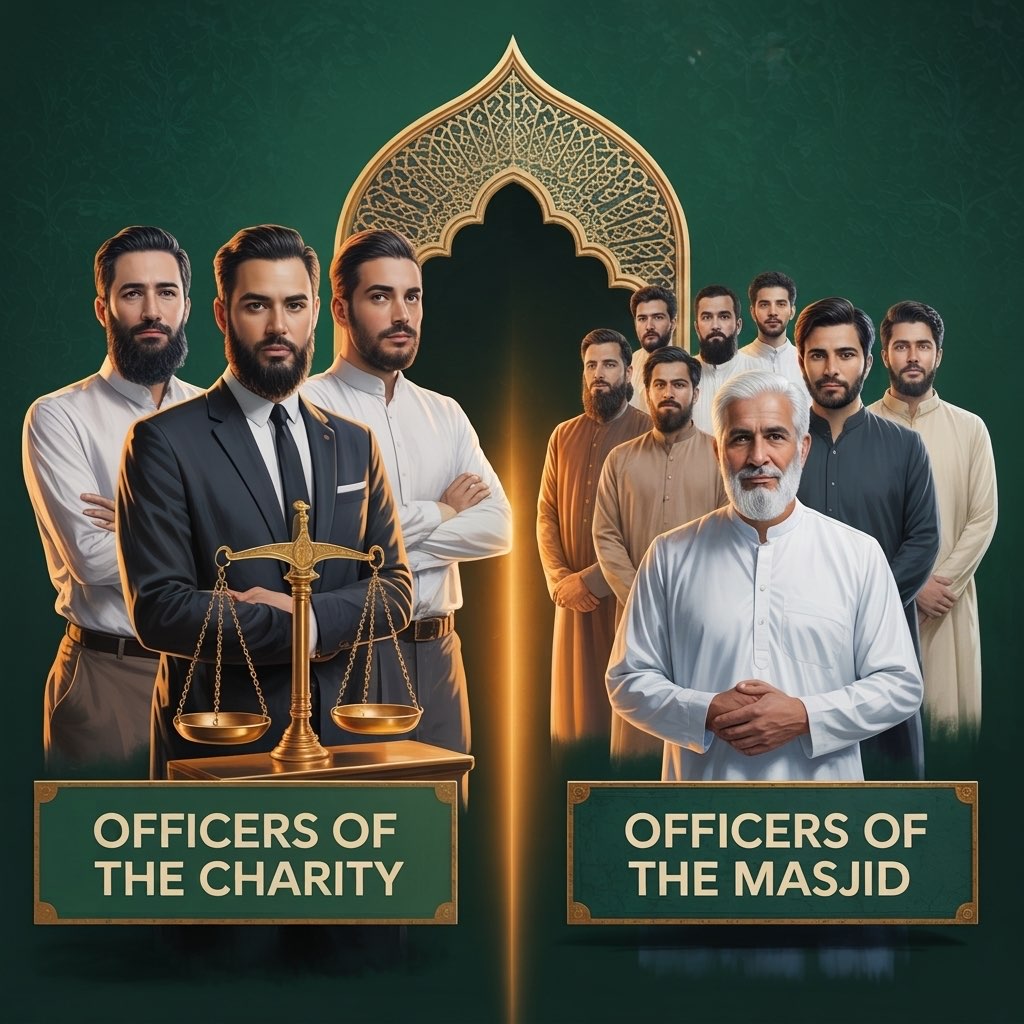
When a single individual occupies both arenas — governance and community leadership simultaneously — accountability becomes unclear and recognition concentrates in one place. The new model makes this structurally impossible.
Every role is distinct. Every person is accountable to a different body. The Amir leads the community. The Service Council Leads deliver the services. Recognition flows to the people doing the visible work.
This is not a complicated model. It is the right model — made simple by the right platform.
Responsible to the community
The Amir and the Service Council Leads are the face the community sees, knows, and works with every day. Their arena is the prayer hall, the khutbah, the madrasa, and the welfare of the people.
They stand between the adhaan and the iqamah on Jumu'ah. They make the community address. They coordinate the welfare visit. They ensure the madrasa runs. They organise Eid. They are present, visible, and operational — and they receive the recognition that comes with visible service.
The Jumu'ah community address rotates. Every Service Council Lead gets the platform. Every person with a leadership role gets to present their work to the community. No single voice dominates. No individual monopolises the platform.
This is a role of service. Not power. Not politics. Service. And the platform ensures they can focus entirely on delivery — because it handles everything else.
What success looks like
Every masjid has two structures — and both are working
The Officers of the Charity govern quietly in the background. The Officers of the Masjid lead visibly at the front. No single person occupies both. No role bleeds into another. The Charity Commission's file is clean. The community's experience is warm. Both are true at the same time.
The Amir leads — and then steps aside
A servant-leader, chosen by shura, serves the community for one year. He delivers. He is recognised. He steps aside. Another rises. No one accumulates power. No one becomes irreplaceable. Fresh leadership, fresh energy, the same community served continuously and well. The Islamic principle of rotation — embedded in the constitution and enforced by the platform.
The musallees trust what they cannot see
They trust the finances because the platform publishes them. They trust the elections because the platform ran them. They trust the governance because the platform enforces it. They do not need to know charity law. They need to know it is being followed. The platform gives them that certainty — automatically, continuously, without anyone having to ask.
Communities stop fracturing over governance
The disputes that have divided masajid for decades — who controls the announcements, who called the election correctly, who authorised the spend — become structurally impossible. The platform handles all of it. Energy that was consumed by conflict returns to worship, education, welfare, and community.
A model that belongs to the ummah
The UK has one of the most structured charity frameworks in the world. A governance model that merges Islamic principles with charity law, enforced by a purpose-built platform, does not belong to one masjid. It belongs to every masjid. What works here can work in Birmingham, Bradford, Leicester, and beyond — and insha'Allah, for Muslim communities wherever they are.
"Indeed, Allah commands you to render trusts to whom they are due." — Surah An-Nisa, 4:58
This ayah is the foundation of everything Masjid Amanah is built on. Governance is not bureaucracy. It is amanah. And amanah is a command.